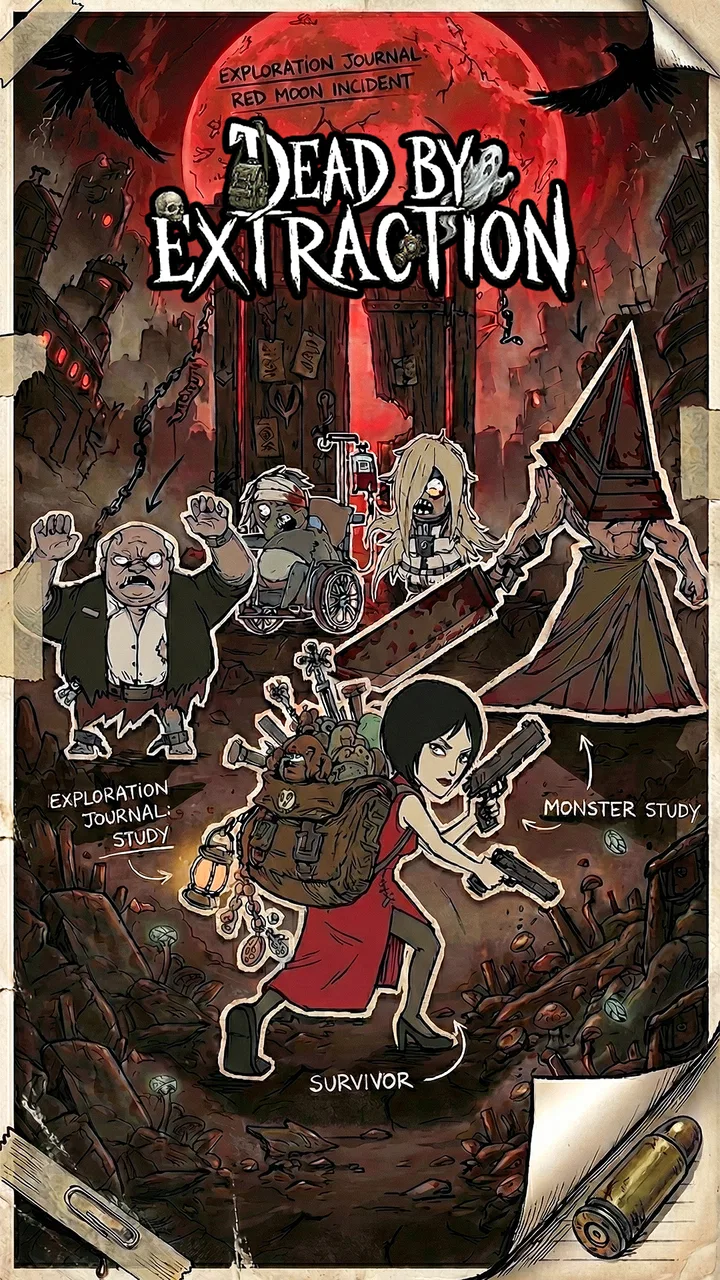
Dead by Extraction
- 4.3
- Rating
- 500.00K
- Installs
- Free
- Price

 Analysis by App-foxy
I spent time with Dead by Extraction as a mobile role-playing game built around a simple but demanding idea: collect what you can, survive dangerous encounters, and make it through the night. That loop gives the game a tense identity, but it also makes the way information is presented especially important. In a game where a rushed decision can cost a run, clear menus, readable combat feedback, and comfortable controls matter almost as much as the loot itself.
My overall impression is cautiously positive. The game is free to start, comes from PIXEL RABBIT LIMITED, and has reached a 4.4 average from around 758 ratings, with more than 10K installs. Those figures suggest that it has already found an audience, although the relatively small install base means I would still treat it as a developing experience rather than a fully established mobile standard. Its age guidance is Everyone 10+, and the current release is version 1.0.2 for devices running Android 7.0 or later.
How clearly the game communicates during a run
The strongest part of the experience is the way its central loop gives every action a clear purpose. Loot is not merely decoration, and fighting is not just a separate activity from survival. The game asks me to think about what I am carrying, when I should engage, and when staying alive is more valuable than chasing another reward. That relationship makes the interface easier to understand because the screen is always serving a recognizable decision: move, inspect, fight, or escape.
You May Also Like

 Blood Strike: 2.5 Anniversary
Blood Strike’s Loadouts Turn Every Drop Into a Tactical Gamble
A close look at Blood Strike’s custom loadouts: how fast access to signature weapons reshapes its battle royale rhythm, rewards preparation, and narrows the gap between fights.

 Pandora - Music & Podcasts
Pandora’s Music Is Easy to Start, but Harder to Recover
Pandora’s strength is its low-effort path from a seed to a station. Its weak spot is how much confidence it asks you to place in connection, setup, and quiet recovery.

 8 Ball Pool
 Is Built on Rivalries, Rematches, and Routine
A close look at the rivalries, rematches, shared routines, and unanswered safety questions that turn a quick pool match into a persistent mobile community.

 Samsung Music
’s Quiet Strength Is Playing What You Already Own
Its reach comes less from spectacle than from dependable access to a personal library. That simplicity is both the app’s strongest retention engine and its ceiling.

 AccuWeather: Weather Radar
AccuWeather Review: A Quick, Clear Forecast for Everyday Decisions
For everyday plans, the best forecast is the one you can understand quickly. AccuWeather makes rain timing, radar, and local conditions easy to act on, with a few trade-offs.

 Hill Climb Racing
Why Hill Climb Racing Still Turns Crashes Into One More Run
A tiny car, a bumpy hill and one more upgrade: Hill Climb Racing keeps resurfacing because its simple chaos makes every near-miss feel personal.
More From Our News Desk
View All News


For a new player, the short store phrase “Dead by Extraction” sets a darker expectation than a conventional fantasy role-playing game. I would not approach this as a relaxed character-collection title or a slow menu-driven adventure. The appeal comes from pressure and uncertainty. If you enjoy games where a successful retreat feels as satisfying as defeating an enemy, the design has a clear hook. If you prefer predictable progression and generous time to read every option, the pace may feel less welcoming.
Navigation is most comfortable when I treat each session as a sequence of small decisions rather than one long mission. I found it useful to pause mentally after collecting something important and check whether it actually supports my current plan. This is a practical habit in extraction-focused games: a full inventory can become a problem if it leaves no room for a better item, while rushing toward every visible reward can expose me to unnecessary danger.
The most useful accessibility-minded habit is to reduce the amount of information I process at once. Instead of trying to memorize every item immediately, I focus first on what affects survival, then on what might improve a later run. That approach helps players who find dense screens tiring, and it also makes the game more enjoyable for anyone playing on a small phone during a short break.
Reading the screen without losing the moment
Readable presentation is especially important here because the game combines role-playing decisions with immediate danger. I recommend playing the opening sessions somewhere with steady lighting and using a device size that lets you distinguish icons without squinting. A larger screen can make inventory comparisons and combat indicators easier to interpret, while a small phone may be more convenient but demand more visual concentration.
I would also avoid making important decisions while distracted. A crowded commute, a noisy room, or a screen covered by glare can turn a manageable encounter into a confusing one. This is not a criticism unique to mobile games; it is a direct consequence of combining quick reactions with item management. The game is easier to follow when I give it a few uninterrupted minutes rather than treating every session as something I can play with half my attention.
The role-playing structure gives the experience more depth than a simple action game, but it also creates more opportunities for visual overload. Players who like comparing equipment and planning routes will probably appreciate that extra layer. Players with reading fatigue may prefer shorter sessions, making one clear objective their priority instead of attempting to understand every option at once.
Controls, timing, and different ways of playing
Motor demands are likely to be most noticeable during combat or escape moments, when the game’s survival theme becomes more than atmosphere. I found that the best approach is to keep my hands relaxed and avoid frantic input whenever possible. Panic tends to produce worse decisions: I tap too quickly, lose track of the important threat, and forget the reason I entered the area in the first place.
That does not mean the game is equally comfortable for every player. Anyone with limited dexterity, hand fatigue, tremors, or difficulty with rapid repeated touches may find tense encounters harder than the quieter parts of the experience. I would not choose this title specifically for low-demand play. It rewards attention and timely responses, so players who need generous pauses or very simple controls should consider whether that pressure is enjoyable rather than assuming the role-playing label means a slow pace.
Short sessions can help. Instead of playing until my hands or eyes feel strained, I prefer stopping after a successful extraction or a clear setback. This creates a natural break point and prevents a difficult run from turning into a long period of frustrated input. It is also a sound strategy for players who use one hand, switch between devices, or need to divide gaming time around work, study, or care responsibilities.
Sensory comfort is another consideration. A night-survival theme naturally leans toward tension, contrast, and urgency. Players who are sensitive to sudden visual changes, intense atmosphere, or frequent alerts should test the opening experience in a comfortable setting and keep the volume at a level that does not add unnecessary stress. I would not claim that the game offers specialized sensory controls, so the safest recommendation is to rely on the device’s own display and audio adjustments where needed.
Why context changes the experience
Dead by Extraction works best when I can concentrate for a brief, defined period. A quiet evening is ideal because I can weigh the risk of another encounter instead of making a rushed choice. It can also work during a short break, provided I begin with a modest goal and accept that I may stop before completing everything I intended. The extraction structure makes that flexibility useful: a session can still feel meaningful when the result is simply bringing valuable loot out safely.
It is less suitable for situations where interruptions are unavoidable. If I expect a call, a meeting, or frequent movement between tasks, I would avoid starting a risky section. A sudden interruption can break my awareness of the current threat and make the game feel unfair when the real problem was the environment. For players who need to stop instantly, the safest routine is to use low-risk moments for casual play and reserve demanding encounters for uninterrupted time.
One realistic example is playing after work on a phone while waiting for dinner. I can complete a short objective, sort the most useful loot, and stop after a safe return rather than chasing one more reward. That routine suits the game better than trying to force a long campaign session into a five-minute gap. The same principle applies to students between classes or parents with unpredictable free time: plan around successful stopping points, not around an assumed amount of continuous play.
Network conditions, battery level, and screen comfort also influence whether a session feels accessible, even when they are not part of the game’s role-playing design. I would begin a serious run with enough battery, a stable connection if the game requires one during play, and notifications under control. These are ordinary mobile precautions, but they matter more when losing concentration can undo careful preparation.
Where the game may create friction
The biggest barrier is the tension between accessibility and the game’s intended pressure. A survival loop needs consequences to feel meaningful, yet consequences can be discouraging for people who need more time to interpret a screen or execute a sequence. That trade-off is not automatically a flaw, but it means the game will not be a universal recommendation. Its appeal depends on whether the player finds urgency exciting or exhausting.
The free entry point is helpful because it lets curious players judge that balance without committing to a purchase. At the same time, in-app items range from $4.99 to $29.99 each. I would approach those purchases carefully and first decide whether the basic loop feels comfortable, readable, and worth returning to. Spending money cannot solve a control or sensory mismatch, so the sensible order is to test the game, learn its rhythm, and only then consider whether optional purchases fit your budget.
That pricing range may also affect how different players experience progression. Someone who wants a completely even, no-spending environment may prefer another role-playing game with fewer purchase prompts or a different business model. Someone comfortable treating optional purchases as a way to support a free game may find the arrangement acceptable, but I would still set a personal spending limit before playing regularly.
The age guidance of Everyone 10+ gives families a useful starting point, but it does not answer every practical question about individual comfort. A younger player may handle the controls well but dislike the survival tension, while an older player may enjoy the theme but struggle with small-screen reading or rapid input. I would make the decision based on the person’s tolerance for pressure and their comfort with mobile controls, not on the age label alone.
Another limitation is that the game’s core appeal can narrow its audience. Players looking for a story-first role-playing adventure, a peaceful collection game, or a purely turn-based experience may find the extraction focus distracting. The title is at its best when risk, loot, and retreat are connected. Remove that tension from the equation and much of what makes it distinctive disappears.
How it compares with familiar role-playing alternatives
Compared with a conventional mobile role-playing game built around quests and steady upgrades, this one places more importance on what happens during a single run. Traditional alternatives are often easier to play while distracted because the player can stop between battles, read dialogue, or manage a menu without the same sense of immediate danger. Dead by Extraction is more compelling for me when I want decisions to carry short-term weight rather than simply move a character along a predictable path.
Compared with a pure action game, it offers a stronger reason to think about what happens after combat. Winning a fight is not necessarily the complete objective; the value comes from surviving long enough to make the result matter. That makes it a better choice for players who enjoy planning and risk assessment, while fast-action fans who only want immediate combat may find the inventory and extraction concerns slow the momentum.
It also differs from relaxed loot games because the reward is tied to danger. I cannot judge an item only by how attractive it looks in isolation. I have to consider whether pursuing it is worth exposing the run to another threat. That is one of the game’s more interesting design decisions, and it creates a useful advanced tactic: define a stopping rule before entering a risky area. For example, I might decide that once I have secured one valuable item, I will leave unless the next opportunity is clearly safer than the route back.
This kind of self-imposed discipline is particularly helpful for players who become absorbed in completion goals. The game encourages curiosity, but curiosity can become a liability when I keep extending a successful run. Treating extraction as a real objective rather than an afterthought makes the experience less chaotic and gives players who prefer structured play a clearer way to manage the tension.
Who should try it and who should skip it
I would recommend this game to players who enjoy role-playing systems with a survival edge, especially those who like deciding when to take a risk and when to leave with what they have. It is also a good fit for people who want a free mobile game that can support short, purposeful sessions rather than requiring a long uninterrupted evening. The combination of loot and danger gives each successful return a satisfying sense of consequence.
I would be more cautious about recommending it to players with limited tolerance for rapid input, dark or tense presentation, or visually busy decision-making. It may also disappoint anyone searching for a calm game to play while watching television. The game asks for attention, and its most interesting choices lose their impact when I am only half engaged.
Players who are sensitive to spending pressure should begin with a strict no-purchase trial. The free starting point is enough to evaluate whether the interface and rhythm suit you, while the available item prices make it sensible to avoid impulse decisions. I would also suggest trying it on the device you actually plan to use, because a game that feels readable on a tablet may be less comfortable on a compact phone.
My inclusive verdict after playing
Dead by Extraction is most successful when its tension feels like a choice rather than a barrier. I like the way loot, combat, and survival reinforce one another, and I appreciate that a safe retreat can be as meaningful as a victory. The game has a clear identity instead of blending into the usual role-playing crowd, and its free price makes experimentation straightforward.
Still, inclusive design here depends heavily on context and personal comfort. I would play in short sessions, reduce distractions, use a screen that makes item information easy to read, and stop before hand or eye fatigue turns a tense game into an unpleasant one. Those habits do not change the game’s controls or presentation, but they make its demands easier to manage.
With a 4.4 average and a current version of 1.0.2, it is worth a look for Android players who want a more pressured alternative to standard role-playing adventures. I would not call it the safest choice for every ability or play environment, and I would not spend on in-app items until the basic experience proves comfortable. For the right player, though, the central question—how much can I risk before I leave—creates a focused, memorable mobile loop that is easy to understand and surprisingly difficult to master.
FAQs for Dead by Extraction
01What is the primary objective in Dead by Extraction?
In Dead by Extraction, the main objective is to strategically navigate through various levels, completing missions and extracting resources while avoiding or defeating hostile forces. Players must work collaboratively or solo to achieve their goals, making decisions that impact their survival and the outcome of each mission.
02Is Dead by Extraction available on both Android and iOS?
Yes, Dead by Extraction is available for download on both Android and iOS platforms. Users can find it on the Google Play Store for Android devices and the Apple App Store for iOS devices. Ensure your device meets the minimum system requirements for optimal performance.
03What are the key features of Dead by Extraction?
Dead by Extraction offers a range of features, including immersive graphics, diverse mission types, and a variety of weapons and tools. The game also includes multiplayer modes, allowing players to team up with friends or other online players. Regular updates introduce new content and challenges to keep the gameplay fresh.
04Are there in-app purchases in Dead by Extraction?
Yes, Dead by Extraction includes in-app purchases that allow players to buy additional resources, weapons, or cosmetic items. While the game is free to download, these purchases can enhance the gaming experience. Players should monitor their spending to ensure they stay within their desired budget.
05Can Dead by Extraction be played offline?
Dead by Extraction primarily requires an internet connection for multiplayer features and updates. However, certain aspects of the game may be accessible offline, but players will miss out on the full experience, including real-time team missions and leaderboards. For the best experience, a stable internet connection is recommended.
Pros
- Engaging storyline with immersive gameplay.
- High-quality graphics enhance the experience.
- Co-op mode for team-based strategy.
- Regular updates with new content.
- Intuitive controls for smooth navigation.
Cons
- Requires constant internet connection.
- In-app purchases can be expensive.
- Occasional server lag issues.
- High battery consumption during play.
- Limited character customization options.

Dead by Extraction
Gallery